
Johnson County Criminal Court Cases
Johnson District Court handles misdemeanors, violations, traffic matters, and the first judicial steps in many felony prosecutions. Johnson Circuit Court is the felony trial court. Both sit within the Kentucky Court of Justice, and both local files are kept by the Johnson Circuit Court Clerk. That division explains why the same event can produce an F case in District Court and a later CR case in Circuit Court after grand-jury action. A search limited to one case number may show only part of the prosecution.
The official local file lives at the Johnson County Judicial Center, 908 Third Street, Suite 109, Paintsville, KY 41240. The clerk's counter is open Monday through Friday from 8 a.m. to 4 p.m. Call 606-297-9567 or fax 606-297-9573 to confirm the right court, current procedure, and document availability. Staff can identify records and explain access steps, but they do not interpret a ruling's legal effect.
The official Johnson County court page shows the judicial center and its criminal schedule.
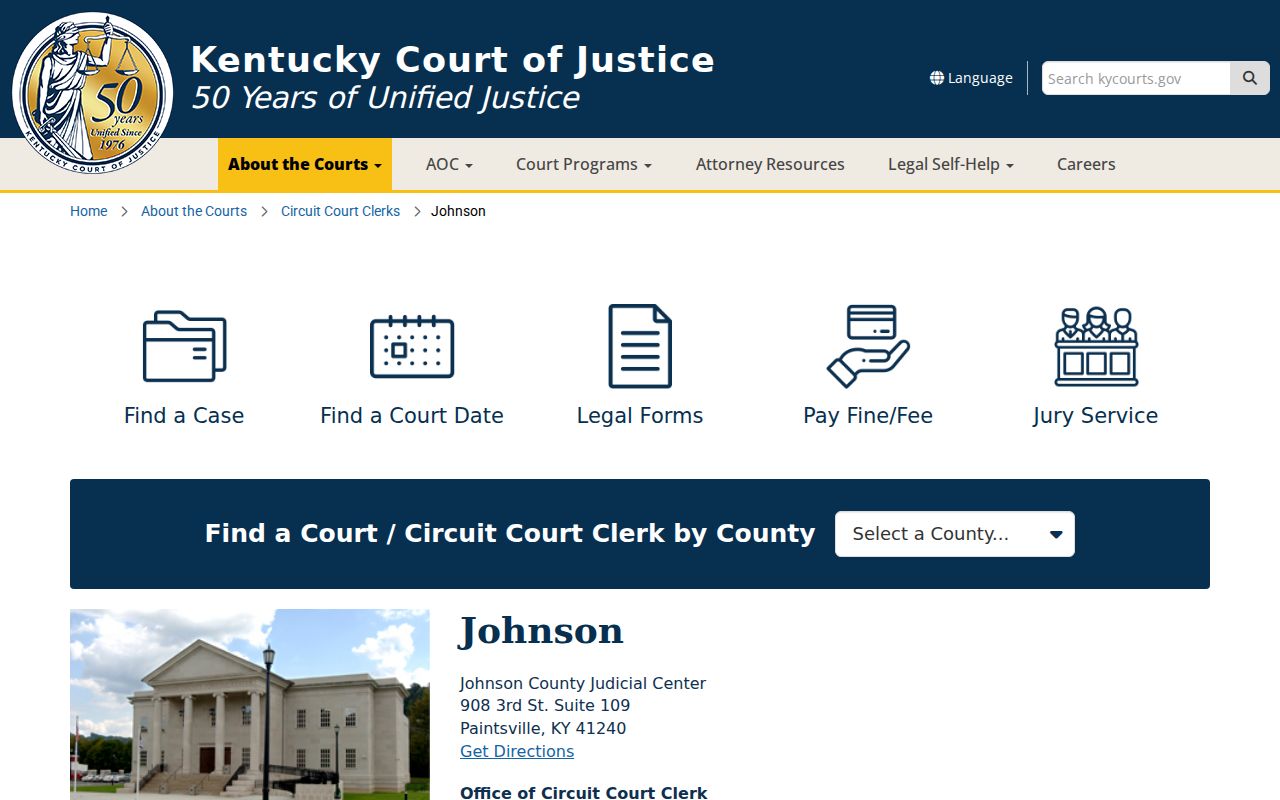
That source is the best place to confirm local contact details before requesting a Johnson County court file.
Johnson County Court Records at Suite 109
Suite 109 is the practical starting point when the signed case file matters. Give the clerk a full legal name, date of birth if known, an approximate filing year, and any case or citation number. Ask whether the entry is a District T, M, or F matter or a Circuit CR case. Then identify the exact docket items needed, such as the citation, indictment, plea, motion, judgment, sentence, or financial ledger. A narrow request helps the clerk locate public documents and identify items that require redaction.
Do not confuse this office with the Johnson County Clerk at 230 Court Street. The County Clerk handles land, vehicle, election, and county administration records. The Circuit Court Clerk holds criminal case files. The county's Circuit Court Clerk page confirms Hillary Chafin Collins as clerk and lists the local weekday hours.
The official clerk profile provides a second source for the Johnson County criminal records counter.
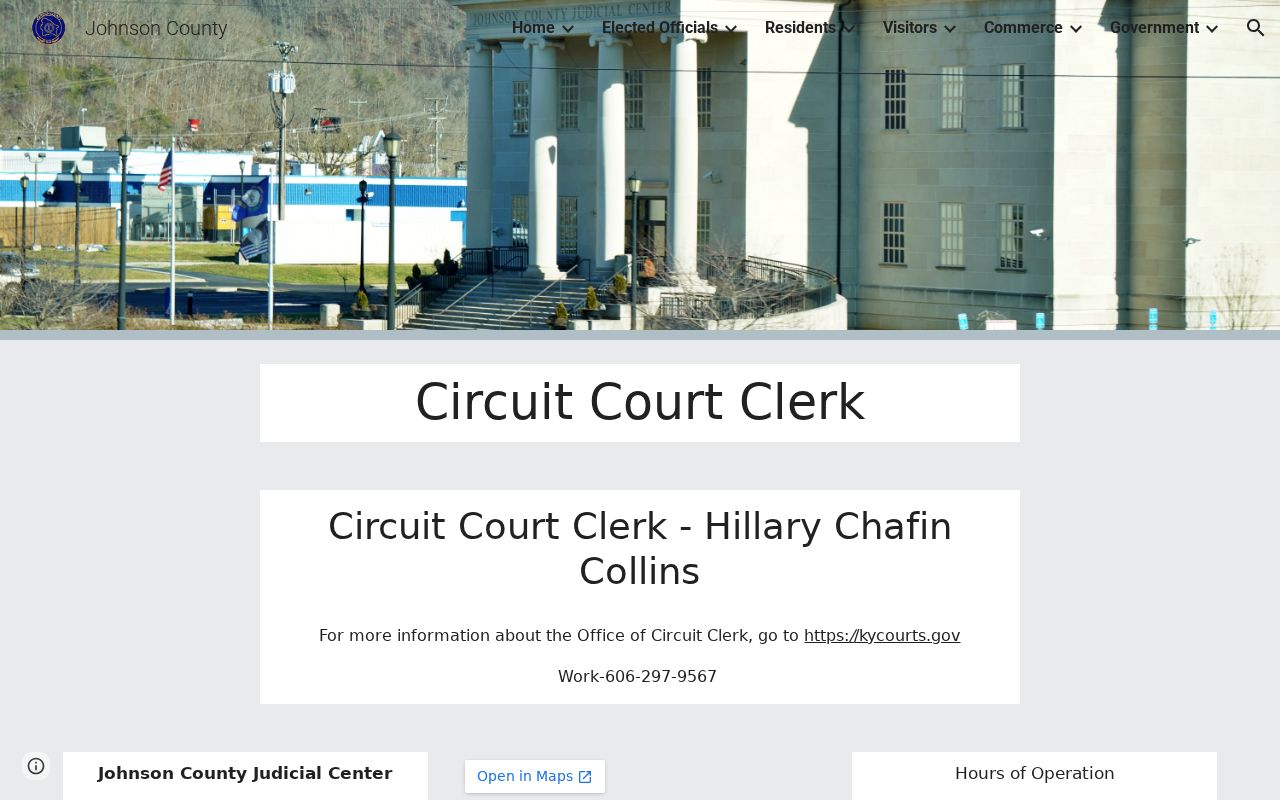
Its office details help a requester reach the correct clerk instead of the county administrative records office.
Searching Johnson County Case Records
There is no free, anonymous Johnson-only docket search documented by the Kentucky Court of Justice. CourtNet 2.0 holds statewide public case information, but full remote use is generally subscription or authorized-user access. The county clerk counter and phone line remain the direct route to the official file. FastCheck and One-Time Request can produce a statewide CourtNet report for $25, plus a card surcharge of 2.25 percent or $2.50, whichever is greater. That report is marked “Not an Official Court Record.”
Use this sequence to find the correct Johnson County criminal case without mistaking a summary for the entered court file:
- Gather the subject's full name, date of birth if known, filing year, and case or citation number.
- Call or visit the Circuit Court Clerk and ask whether the record is District T, M, or F, or Circuit CR.
- Inspect the docket and compare the original charge, any amendment, the disposition, and the disposition date.
- Name the public pleading, order, recording, transcript, or certified copy needed, then ask the clerk about cost and delivery.
- Order FastCheck only when a broader Kentucky court-history summary is useful, and compare unclear entries with the signed Johnson County file.
FastCheck registered users retrieve completed results online for 30 days. One-time users receive results by U.S. mail. AOC does not expedite an order. If someone requests another person's report and a record is found, AOC notifies that subject and sends the subject a copy.
Other official AOC channels include a mailed request and weekday in-person service at the AOC Records Unit, 1001 Vandalay Drive, Frankfort. Mail payments use a check or money order payable to Kentucky State Treasurer. The in-person office does not accept cash, and card payments carry the stated surcharge. Kentucky appellate public access serves appellate matters, while the Johnson County clerk remains the source for the local trial file.
| Search field | Type | Required | Use |
|---|---|---|---|
| First name | Text | Yes | Use the legal given name. |
| Middle name or initial | Text | Unspecified | Helps separate close matches. |
| Last name | Text | Yes | Use the current legal surname. |
| Maiden name or alias | Text | Optional | Add a known prior name. |
| Date of birth | Date | Yes | Primary identity match. |
| Requester contact | Text | Yes | Supports delivery and required notice. |
| Payment | Card or account | Yes | Covers the report and applicable surcharge. |
Kentucky Case Codes in Johnson County
A case suffix is a compact label for the court track, not the result. T identifies traffic material. M marks a misdemeanor. F is a felony charge at the District Court stage. CR identifies a Circuit criminal case. KRS 532.020 supplies Kentucky's offense designations, while the current KRS Chapter 532 contains the related sentencing framework. A felony arrest can start in F and later become CR, so the number changes as the matter moves between courts. Search both stages when the timeline seems to stop before a felony disposition.
- Original charge
- The allegation first filed in that court case.
- Amendment
- A change to the legal charge after filing.
- Disposition
- The court's recorded outcome for a charge or case.
- Clerk memo
- A note that may clarify an irregular report entry.
Charge date and disposition date describe different events and may be far apart. A dismissed, amended, or reduced charge should be read with the final outcome. AOC's Records Unit can help correct some data, but it cannot give legal meaning to a code. For an entry tied to Johnson County, the filing clerk's official docket and signed order control.
Inside a Johnson County Case File
The court file is broader than a booking entry or a statewide report. Kentucky's official court-record request page lists citations, pleadings, motions, orders, evidence, reports, dockets, video recordings, and transcripts among common case materials. Whether a particular item exists, is public, or can be copied depends on the file and access rules. Ask for specific items rather than requesting “everything.”
| Case number and court | Shows T, M, F, or CR type, filing court, county, and key dates. |
|---|---|
| Charging document | Shows the citation, complaint, or indictment and each count as filed. |
| Docket events | Lists arraignment, hearings, motions, pretrial dates, plea or trial, and judgment. |
| Charge history | Separates the original allegation from amendments and final disposition. |
| Orders and judgment | Contains the judge's entered rulings and the official case outcome. |
| Sentence and finances | May show sentence terms, costs, restitution, and ledger events. |
| Access status | Identifies sealed, redacted, or otherwise restricted documents. |
The Court of Justice request resource also explains why the local clerk, not AOC's administrative open-records office, is custodian of case files.
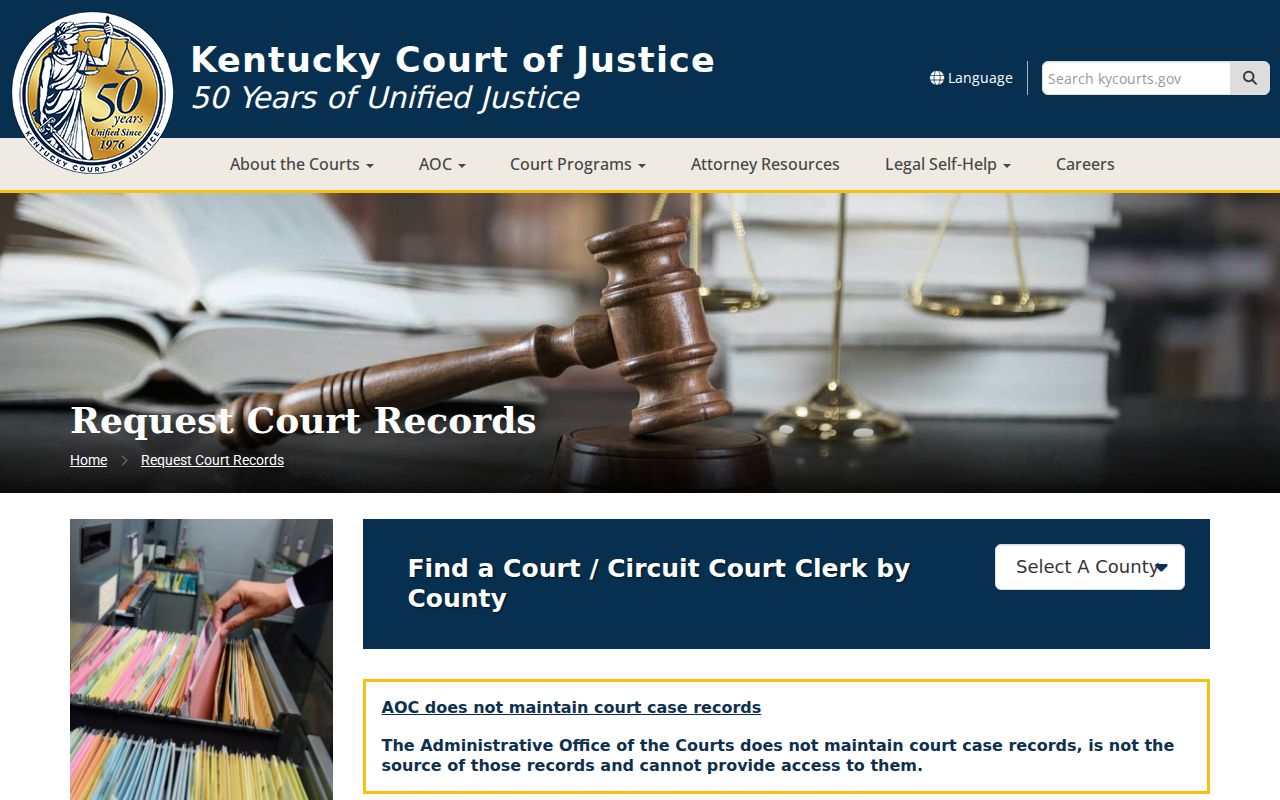
That distinction keeps requests for pleadings and signed orders with the office that holds the original Johnson County record.
Johnson County Felony Cases Change Courts
A felony complaint can begin in Johnson District Court with an F number. That court handles early proceedings, including the first appearance and preliminary felony work. If a grand jury returns an indictment, the felony proceeds in Johnson Circuit Court under a CR number. The District docket does not become false or vanish. It records an earlier stage. The Circuit file then carries the indictment, motions, plea or trial, judgment, and sentence.
This split matters when a booking charge differs from the judicial result. Police and jail records capture what was asserted near the arrest. The prosecutor decides what to file and may change the charge. The court records later action. If only the initial allegation appears, compare it with the filed charge and disposition after reviewing the Johnson County arrest record. Matching dates, agency, and case numbers helps connect the layers without treating them as identical.
Note: A change from an F number to a CR number reflects the court path, not a second conviction.
How a Criminal Case Moves
Johnson County case records grow by stage. The charging document starts the court record. Arraignment records the plea and key scheduling action. Pretrial entries track motions, discovery disputes, conferences, and other preparation. A plea or trial resolves contested charges, but the case is not fully read until the disposition and entered judgment are checked. Sentencing may occur on a later date and can add costs, restitution, custody, or supervision terms.
Case flow: Charges Filed › Arraignment › Pretrial › Plea or Trial › Disposition › Sentencing
Not every case uses every step. A charge can be dismissed or amended, and some hearings may be reset. Docket text is a calendar and event trail, not always the final order. Read the disposition date with the judgment and sentence. If the docket names a recording or transcript, ask the clerk whether it was created, whether it is public, and how to request it.
Johnson County Court Fridays Explained
Johnson Circuit Court's published criminal sessions fall on the second and fourth Friday of each month. Arraignments, motions, and sentences begin at 9 a.m., while pretrial conferences begin at 11:30 a.m. Circuit motion hour is the third Friday at 9 a.m., and motions are due the preceding Friday. District Court dates are set months in advance, so the clerk directs callers to ask for current motion hours.
These facts help decode an upcoming docket entry. They do not promise that a particular case will be heard on a listed date. A continuance, new order, or calendar change can alter the schedule. Confirm the current event with the Circuit Court Clerk before relying on an old docket notation. The clerk can say what the calendar shows, while the entered order explains what the court actually decided.
Case Record Access & Restrictions
Many Johnson County criminal case records are open for inspection, but access has firm limits. Juvenile court records are generally confidential under KRS 610.340. Sealed records, grand-jury material, confidential victim data, mental-health matters, and protected evidence may be withheld or redacted. Expunged cases are omitted from the public AOC report. An online absence can also result from a date limit, identity mismatch, purge, federal filing, or a case in another state.
Kentucky Open Records Act procedures govern many agency records, but judicial case files remain under Court of Justice rules and local clerk custody. Do not send a case-file request to AOC's administrative open-records office. Ask the Johnson Circuit Court Clerk which docket documents are public and what copy or certification charge applies. No local official fee chart was found, so the price should be confirmed before ordering.
Federal Cases Outside Johnson County Courts
Federal prosecutions do not appear in Kentucky FastCheck or the Johnson County clerk's state-court files. Johnson County lies in the U.S. District Court for the Eastern District of Kentucky. The official PACER system supplies federal dockets and documents after account registration, subject to its current fee rules and access limits. A federal docket is a separate record layer and does not prove present custody.
The PACER source shows the federal search route that sits outside Johnson County criminal court cases.
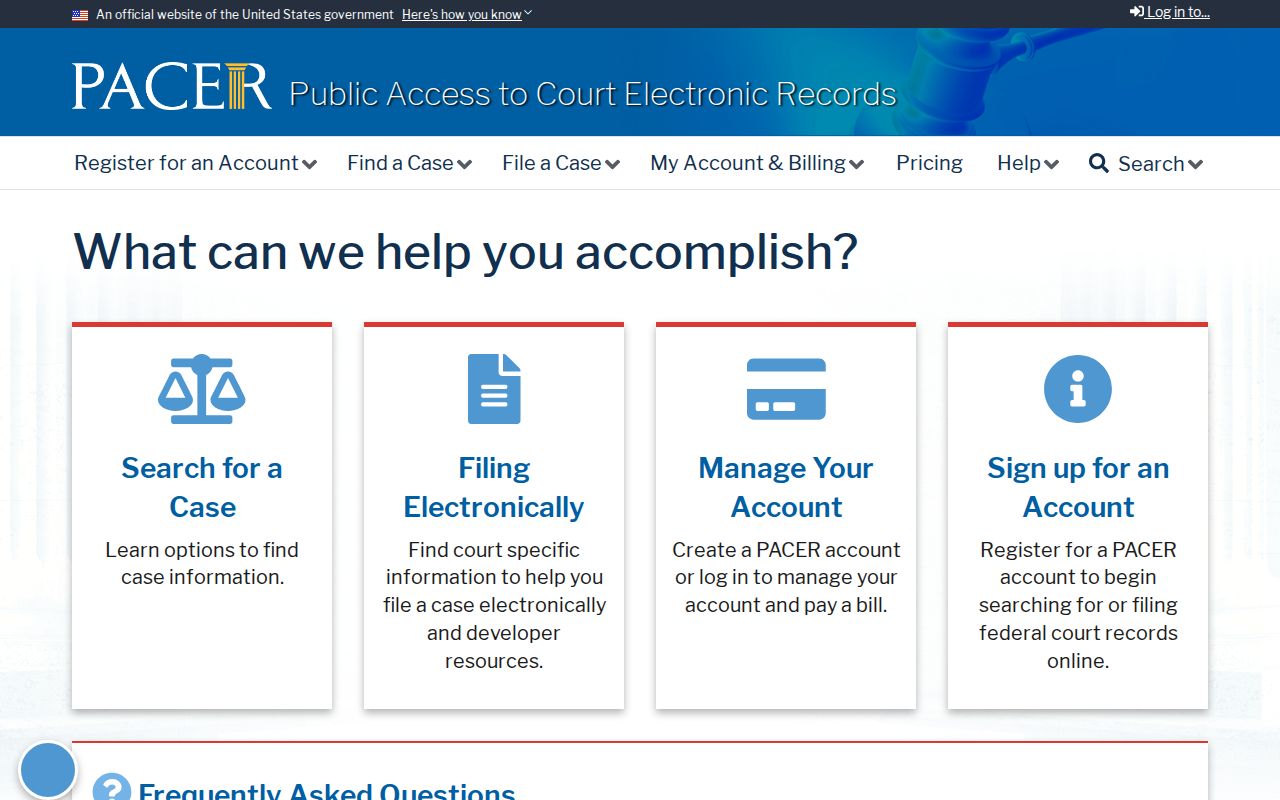
Use the federal docket for federal filings, while keeping Kentucky District and Circuit Court requests with the Johnson County clerk.
Federal custody is another distinct question. The Bureau of Prisons locator addresses federal custody, not the case file. Likewise, an FBI Identity History Summary depends on fingerprint-linked submissions and does not replace the signed federal or state judgment. Keeping those systems separate prevents a PACER docket, a custody record, and a Kentucky court report from being read as though they were the same document.